Feeling like a failure as a mom, when you do everything
Feeling like a failure as a mom, even though you do everything? Why it happens, what the data says, and how to say it out loud and be heard — no advice.
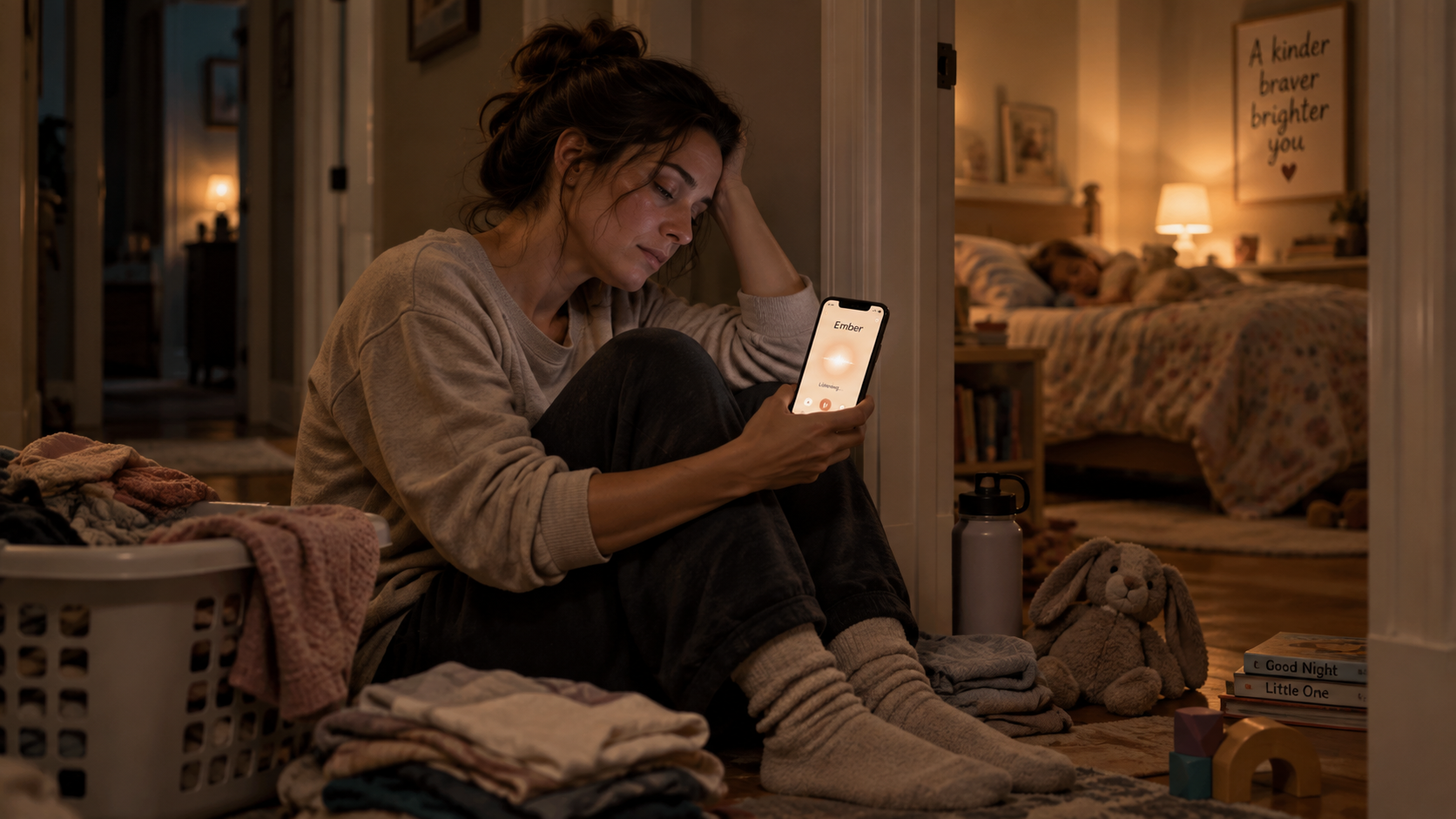
Feeling like a failure as a mom usually means you're holding yourself to a standard no one could meet, while doing far more than you give yourself credit for. The cruel part is that the moms most likely to feel they're failing are often the ones trying hardest — because caring that much is exactly what makes "not enough" hurt.
If your day ends with a quiet "nothing I do is ever enough for them," you are not a bad mom for thinking it, and you are very much not alone in it. Below is what that feeling really is, why it grips the most devoted parents, and what tends to help — starting with being heard rather than handed one more piece of advice.
Say it out loud on Ember · See how it works
Free while in beta · 18+ · Nothing you say is public.
What does feeling like a failure as a mom mean?
Feeling like a failure as a mom means the gap between the mother you think you should be and the tired, human one you are has become loud. It's rarely a response to real failure — it's usually a sign you care deeply and are measuring yourself against an impossible, all-day standard that no parent actually meets.
Left unspoken, one hard moment quietly generalizes. "I lost my temper tonight" becomes "I'm a bad mom," and that sentence starts coloring everything. Naming the feeling accurately — a feeling, not a verdict — is the first step to loosening its grip.
You're not alone — and the data says so
If you feel like you're failing, you're in the majority of parents, not the exception. In Pew Research Center's Parenting in America Today survey, 62% of parents said being a parent has been harder than they expected — and mothers were more likely than fathers to say they feel judged for how they parent. The feeling that you're not measuring up is close to universal; it's just rarely said out loud.
That matters because "everyone else seems to have it together" is usually an illusion built from other people's highlight reels. Most of the moms who look effortless are ending their days with the same quiet doubt you are.
Why "nothing I do is ever enough as a mom" feels true
It feels true because most of what you do is invisible, and invisible work is impossible to feel credit for. You notice the one thing that slipped, not the hundred that didn't, because the hundred never announce themselves. Here's some of what quietly runs through a single ordinary day:
| What you pour in | Why it goes unseen | The line that stays |
|---|---|---|
| Tracking everyone's needs, appointments, and moods | The mental load leaves no visible trace | "I'm holding all of it and still dropping things." |
| Staying patient through the tenth interruption | Only the time you snapped gets remembered | "I yelled — I'm a bad mom." |
| Putting your own needs last, again | Quietly getting through it leaves no trace | "There's nothing left of me." |
| Worrying whether you're doing any of it right | The worrying itself is proof you care | "Nothing I do is ever enough for them." |
The very fact that you worry this much is evidence you're a caring mother — indifferent parents don't lie awake asking if they're enough.
Why does feeling like a bad mom hurt so much?
It hurts because motherhood is bound up with your identity in a way few roles are, so "I'm failing at this" can feel like "I'm failing as a person." When you love your kids this much, every perceived shortfall gets amplified, and the stakes feel total.
There's also the silence and the comparison. Admitting you feel like a bad mom can feel dangerous — like it might be true, or like you'll be judged for it — so you keep it in, and keeping it in lets it grow. The longer "I feel like I'm failing" goes unspoken, the more it hardens into "I am failing," which is a very different, and far less accurate, thing.
What do you do when you feel like you're failing as a mom?
Start by letting the feeling out before you pile on more shoulds. The instinct is to fix it — read another parenting article at midnight, resolve to be more patient tomorrow — but a feeling this heavy needs to be heard first, not managed. You can't out-discipline exhaustion and guilt.
Saying it out loud is what separates the two sentences. When "I'm a bad mom" leaves your head and becomes words that land somewhere, you can start to hear the difference between I had a hard day and I am failing my kids — and put the second one down. You don't need advice for that; you need to stop carrying it alone. If there's no one you can say it to without being judged or fixed, here's more on what to do when you have no one to talk to. This is the same knot people describe across life, explored in giving everything and it still not being enough.
- Name the specific hard moment, not your whole worth as a mother.
- Say it out loud somewhere private, without an audience to perform for.
- Separate one bad day from the story that you're failing.
Saying it out loud, and keeping the story
Ember is a private space to say something like this out loud and be heard — not to get parenting advice, and not to be judged. You talk, by voice or text, about the day you've had; Ember listens for what actually mattered and writes it into one page in your own words. You talk once, and the page is there the same day.
It isn't a mom group that might screenshot you, and it isn't a chatbot that hands you a tidy checklist of tips. The thing you keep is your own page — private, yours to reread or delete — which matters because "I feel like I'm failing my kids" is exactly the sentence you can't safely post anywhere. Sometimes seeing your own words written back is what turns the guilt down enough to breathe.
"I said out loud that I resented how invisible it all was — and the sky didn't fall. It just stopped being the thing I was hiding from everyone, including myself."
An illustrative example of what people bring to Ember. Real notes and stories arrive only inside Ember, never public.
Is it really private?
Yes — private is the default, which matters when the thing you need to say is one you'd never post in a parenting group. Your page is private — never posted, never open to search engines, never tied to your name or voice — and no one can read it unless you separately say yes. You can delete anything whenever you want. Read exactly how Ember protects your privacy and who's behind it before you say a word.
When you need more than a place to be heard
Ember is a place to be heard, not therapy or an emergency service. The weight of parenting can get very heavy, and if it ever tips into thoughts of harming yourself or your child, please reach out to people trained for that moment. In the U.S. you can call or text the 988 Suicide & Crisis Lifeline any time, and anywhere in the world you can find a free, confidential line through Find A Helpline. Reaching out isn't a failure — it's what they're there for.
Frequently asked questions
Why do I feel like a failure as a mom when I do everything?
Because most of what you do is invisible and you're measuring yourself against an impossible, all-day standard. You remember the one moment you snapped, not the hundred things that went right, so a hard day quietly generalizes into "I'm a bad mom" — a feeling, not a fact.
Is it normal to feel like a bad mom?
Yes — it's close to universal. In Pew Research Center's survey, 62% of parents said parenting is harder than they expected, and mothers were more likely than fathers to feel judged for how they parent. The moms who look like they have it together usually carry the same quiet doubt.
Does feeling like a failure mean I actually am one?
Almost always the opposite. The fact that you worry this much is evidence you care deeply — indifferent parents don't lie awake asking if they're enough. "I feel like I'm failing" and "I am failing" are different sentences, and only the first one is usually true.
How do you deal with feeling like you're failing as a mom?
Start by letting the feeling be heard before you add more shoulds. Saying it out loud somewhere private helps separate one hard day from your worth as a mother, so the guilt turns down enough to think clearly — no extra parenting advice required.
What is Ember?
Ember is a free, private space to say what's on your mind out loud and be heard. Instead of giving advice like a chatbot, it listens by voice or text, writes what you said into one private page in your words, and knows what other people who stood in the same place went through. There's no app and no account needed to try it.
Is Ember private, and is it free?
Both. Your page is private — never posted, never tied to your name or voice — and no one can read it unless you separately say yes. Ember is in beta, so calling, texting, and getting your finished story are all free.
You do more than anyone sees. Somewhere, that deserves to be heard.
Try Ember free · See what people bring to Ember
Pause or stop anytime · 18+ · Nothing is public.
