Ways to be heard
Why is anxiety worse at night? What research says
Why worry gets louder at 2 a.m.: what research on night-time mood, insomnia and lost sleep found, what may ease the nights, and what it can't tell you.
By the Ember team · Published November 23, 2026 · 6 min read
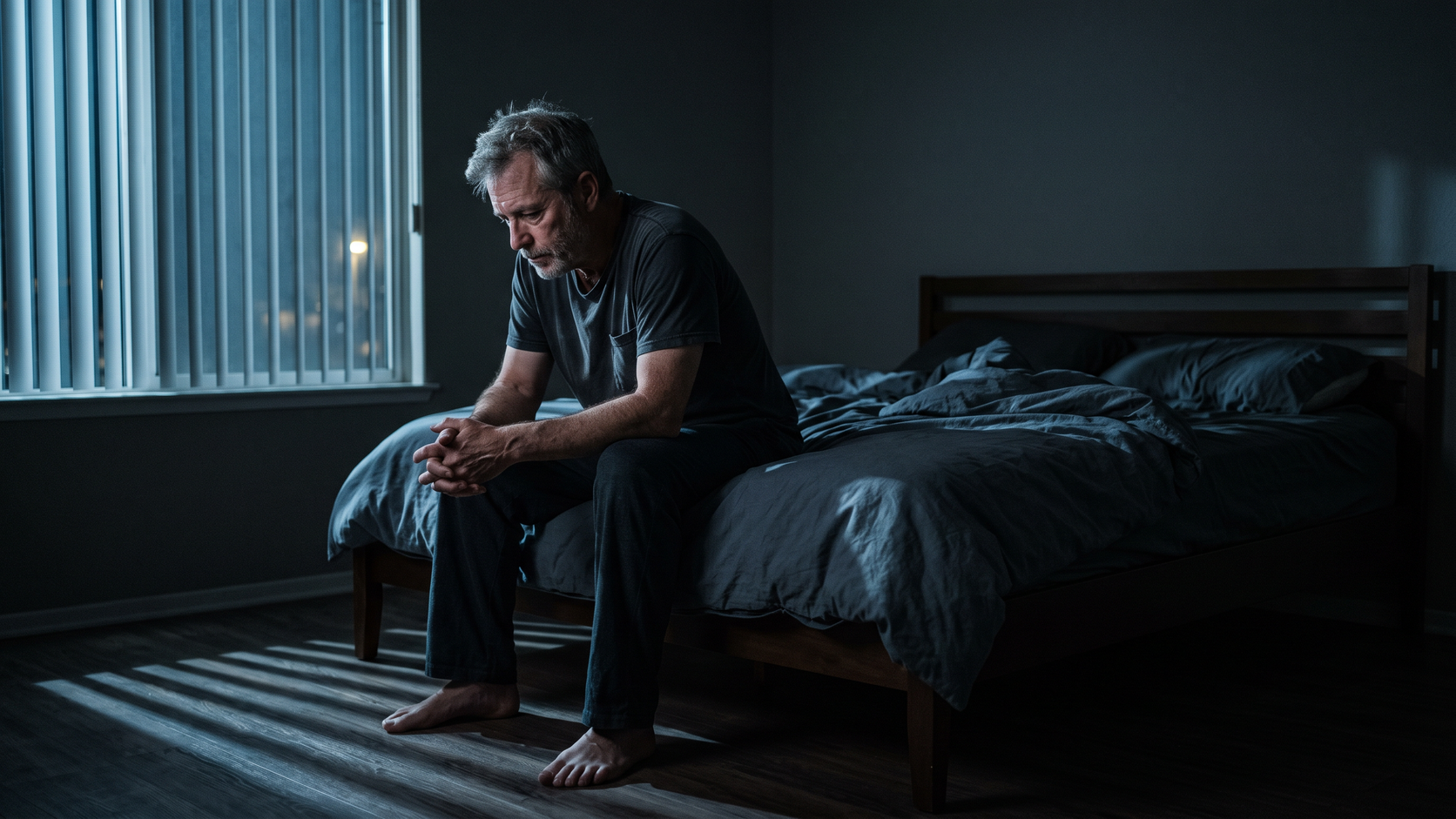
The day was fine, mostly. Then it's 2 a.m., your heart is pounding, and the same thought keeps coming back, a little bigger each time. A bill, a test result, something you said.
A 2022 review by sleep researchers sums up earlier studies this way: good feelings sink to their lowest between 1 and 4 a.m., while bad feelings, steady through the day, peak sharply in those same hours.
The short answer is that several things may stack up at night. Good feelings run lowest then, and researchers propose that the mind at that hour locks onto what's wrong and gives it extra weight. One model of insomnia holds that worry about sleep itself can keep you awake. And sleep problems and anxiety seem to feed each other over time.
What the research says so far
University of Arizona, Penn and Harvard, 2022. Andrew Tubbs and colleagues reviewed research on being awake during the biological night, the hours the body is tuned for sleep. The authors propose what they call the Mind after Midnight: at that hour, low mood narrows attention onto negative or even neutral things and gives them too much weight, while a fatigued front of the brain does less to push them aside. The result can be looping thoughts full of fear and hopelessness. What it doesn't show: that this is proven. "All aspects of this hypothesis require empirical validation," they write; where night-time data were missing, they drew on studies of people after lost sleep.
University of Oxford, 2002. Allison Harvey proposed a cognitive model of insomnia. In it, people with insomnia tend to worry about sleep itself, and about how they'll manage the next day without it. That worry puts the body on alert and stirs up distress, so they watch for signs of trouble and overestimate how little they slept. In the end, the worry may bring on the very lost sleep it feared. What it doesn't show: proof; the paper reviews what it calls preliminary support.
University of Adelaide, 2013. Pasquale Alvaro and colleagues reviewed 9 studies, 8 of which followed people over time, on sleep problems, anxiety and depression. Their reading of the best available evidence: insomnia and anxiety run both ways, each predicting the other later on. What it doesn't show: a settled answer. The authors say definitive conclusions can't be drawn for most sleep problems: the studies were few, ranged from children to older adults, and none adjusted for caffeine.
UC Berkeley, 2019. Eti Ben Simon, Matthew Walker and colleagues brought 18 healthy adults aged 18 to 24 to the lab for two sessions, in random order: one after a night of sleep, one after a night of sleep deprivation. After the sleep-deprived night, anxiety scores rose 27% overnight; after the night of sleep, they didn't change. Brain scans after sleep loss showed less activity in an emotion-regulating area at the front of the brain. In two online studies, 194 and 154 adults kept a sleep diary for two to four nights. A night of poorer sleep than the one before tended to be followed by a more anxious day; changes in hours slept showed no such link. What it doesn't show: much about anxiety disorders, which the lab study screened out, or about a broken night at home. The online studies rested on people's own reports.
University of Illinois at Chicago, 2012. Sarah Kate McGowan and Evelyn Behar randomly assigned 53 people who worry a lot to one of two approaches for two weeks. One group kept worry to a 30-minute period each day, at a set time and place. The other was told not to avoid worry when it came. At the end, the set-time group showed larger drops in worry, anxiety, negative mood and insomnia, though not in depression. What it doesn't show: whether it lasted; the abstract reports the end of the two weeks, and the authors call the results preliminary.
What the research doesn't say
None of these studies shows that anxiety at night means something is wrong with you. Nor do they point to one cause for everyone: the hour, worry about sleep, a bad night before and whatever you're carrying may each play a part. Two of the five are proposals rather than tests.
If it's one conversation on repeat, see why we replay conversations in our heads.
What might take the edge off the nights
- A set appointment for worry. In the Illinois study, a set half hour a day brought larger drops in worry and insomnia than the comparison approach over two weeks. A small, early test.
- A second look by daylight. If the 2022 authors are right, part of how big a problem looks at 2 a.m. comes from the hour itself, not only the problem.
- Getting to morning, and what's underneath. On Ember, the 6 people at Feeling anxious and alone at night found that the night took away the distraction of others and left them facing an emptiness or fear they couldn't name. Some got through the hours with small distractions until daylight. Those who tried to avoid the feeling, through eating or sleep alone, ended up with physical pain or the same fear the next night.
How we built Ember around this
Ember is an AI. It can't tell you why your nights are hard, or make the thoughts stop.
You can say what's going on, by text or voice, any hour; if someone is asleep in the next room, you can type. Ember listens and tries to understand what you mean. It won't tell you what to do. Behind the conversation is what real people in similar situations went through, what they tried, and what happened next, so Ember can tell you how it went for people who've been there. More on talking it out when you can't sleep.
Nothing you tell becomes a public post. No one can read your Ember unless you separately say yes. Ember is an AI; it isn't therapy or an emergency service.
When you need more than a place to think
An AI is not a counselor, a therapist, a doctor, or an emergency service. If night panic or not sleeping goes on for weeks, a doctor is worth telling. If the night has turned into not wanting to be here, or into thoughts of harming yourself, you don't have to be sure it's serious enough: you can call or text 988 any time to reach the 988 Suicide & Crisis Lifeline. If you are in immediate danger, call 911. Anxious and alone at night: who can I talk to? lists what's open at that hour.
Frequently asked questions
Why is my anxiety worse at night?
Research points to several possible reasons. Good feelings tend to be lowest in the small hours, worry about sleep may keep you awake, and poor sleep and anxiety seem to feed each other.
Why do problems feel bigger at night?
Sleep researchers propose that at night, low mood narrows attention onto what's wrong and gives it too much weight, while a tired brain reins it in less. They say the idea still needs testing.
Can lack of sleep make anxiety worse?
In one lab study of 18 healthy young adults, anxiety scores rose 27% after a night of sleep deprivation and didn't change after a night of sleep.
What is Ember?
Ember is an AI you can talk to about what's on your mind, any hour, by voice or text. It listens, remembers what you said, and knows how things went for people who stood where you're standing — what they tried, and what happened after. It won't tell you what to do.
Is Ember private, and does it cost anything?
Ember is private: nothing you tell becomes a public post, and no one can read your Ember unless you separately say yes. Ember is free while it’s in beta. Texting Ember is free, and calls come with 20 free minutes a month; in the US you can buy more, from $4.99 for 35 minutes, and they don’t expire. Ember is for adults 18+.
Things weigh more at 2 a.m. Daylight gets a say too.
Talk it out on Ember
Pause or stop anytime · 18+ · Nothing you tell becomes a public post.
